Healthcare Recruiting: Can AI Solve the Talent Shortage?
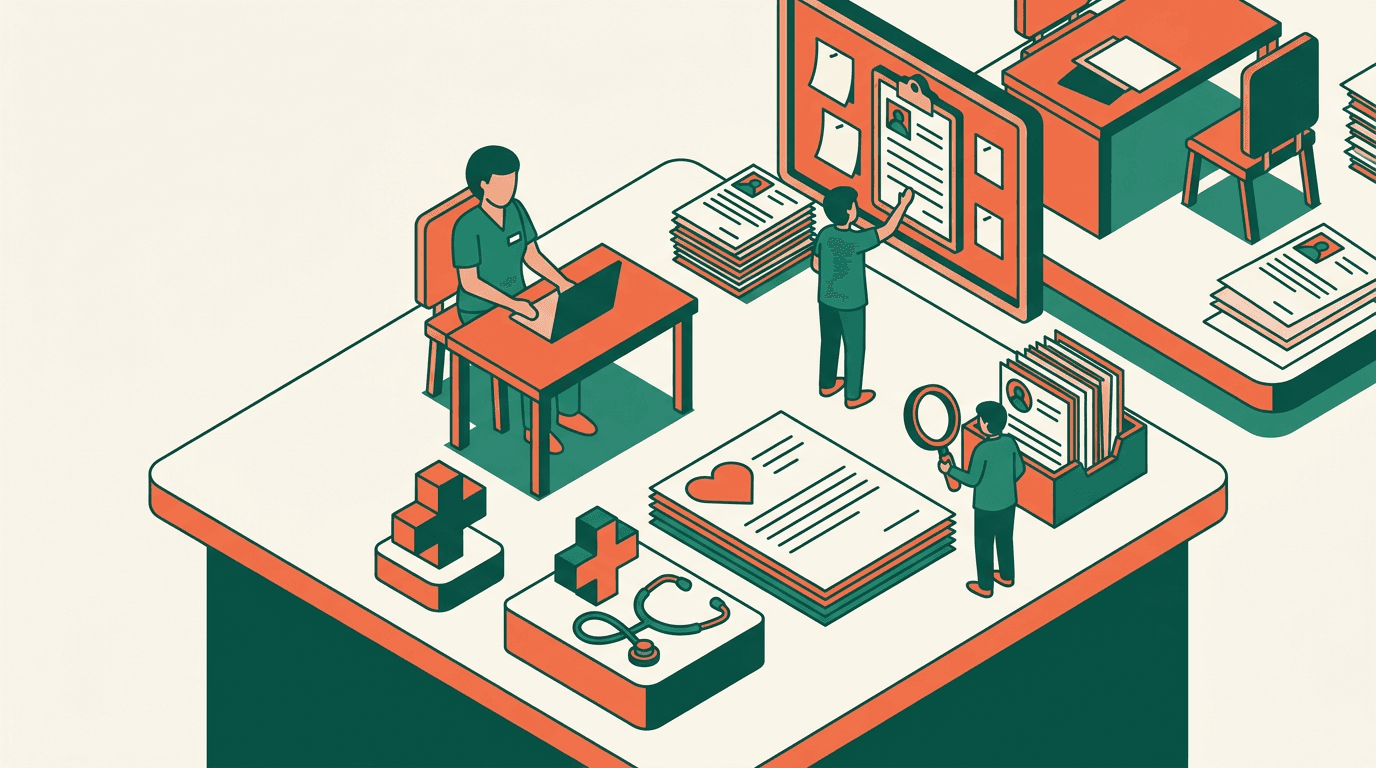
Germany will be short 300,000 healthcare professionals by 2035. Hospitals already report vacancy durations of 200+ days for specialized nursing roles. Every unfilled position costs an estimated 90,000 EUR per year in agency staff and overtime.
The problem is not new. The scale is.
AI can help — but not in the way most people think. It won't create more nurses. It won't make the job more attractive. What it can do is make sure the candidates who do apply get hired faster and more accurately.
The Healthcare Talent Crisis in Numbers
The data paints a clear picture:
- 300,000 projected shortage of healthcare workers in Germany by 2035
- 200+ days average time to fill specialized nursing positions
- 40% of nursing staff consider leaving the profession within 5 years
- 78% of hospitals report recruiting as their top operational challenge
- 13,000 EUR average cost per hire in healthcare (2.7x the cross-industry average)
These numbers reflect a structural crisis. Fewer people enter healthcare training. More leave the profession early. The population ages. Demand rises. Supply falls.
Recruiting cannot solve this equation. But it can stop making it worse.
Why Traditional Recruiting Struggles in Healthcare
Volume Without Infrastructure
A large hospital group receives 3,000-5,000 applications per year. Many HR departments have 2-3 recruiters. That's 1,000-2,500 applications per recruiter per year.
Manual screening at this volume is impossible without shortcuts. Shortcuts mean qualified candidates get overlooked. Overlooked candidates accept other offers. The cycle continues.
Credential Complexity
Healthcare roles require specific certifications, licenses, and registrations. A nurse from the Philippines has different credentials than one from Poland or Germany. Verifying equivalencies manually takes 30-60 minutes per candidate.
Multiply that by 200 international applications per position. That's 100-200 hours of credential checking alone.
Shift-Based and Location-Specific Requirements
Healthcare hiring is not just about skills. It's about availability, location, and shift willingness. A perfectly qualified candidate who cannot work nights is unusable for 60% of hospital positions. Traditional CVs rarely contain this information upfront.
Speed Kills Opportunities
The best healthcare candidates are off the market in 10 days. The average healthcare hiring process takes 45-90 days. By the time most hospitals make an offer, the candidate has accepted elsewhere.
Speed is not a luxury in healthcare recruiting. It is a survival requirement.
What AI Can Do for Healthcare Recruiting
1. Accelerate Initial Screening
AI screening handles the first pass over a large application batch automatically instead of consuming days. For a hospital receiving 500 applications for a head nurse position, this means the longlist is ready within an hour.
HireSift's CV Match Score evaluates each application against your defined criteria: years of experience, specialization, certifications, language skills, and location. The HireSift Score assesses overall candidate quality beyond simple criteria matching.
That's 40 hours of manual work compressed into minutes.
2. Handle Credential Matching
AI excels at structured data extraction. It can parse CVs for specific certifications, license numbers, and training programs. It maps foreign qualifications against German equivalencies.
This doesn't replace formal credential verification. But it identifies which candidates have the right credentials before you invest hours in manual checking.
3. Rank by Fit, Not Just Keywords
A keyword search for "ICU experience" misses the candidate who wrote "3 years in intensive care unit" or "Intensivstation" in a bilingual CV. LLM-based screening understands meaning, not just words.
It also evaluates context. "ICU experience in a 600-bed university hospital" ranks differently than "ICU rotation during training." Both contain the keyword. Only one indicates deep experience.
4. Identify Transferable Skills
A nurse with 5 years in emergency medicine and 2 years in ICU has skills transferable to anesthesia nursing. AI can map these overlaps when criteria are configured correctly.
This matters in healthcare, where specialization paths overlap significantly. Manual screening often misses lateral fit. AI catches it — if the criteria are written well.
5. Process Multilingual Applications
Healthcare recruiting in DACH increasingly involves international candidates. Applications arrive in German, English, Spanish, Turkish, and Filipino. AI screening handles multilingual CVs without requiring translation.
HireSift's LLM-based extraction works across languages. A CV in English is evaluated against the same criteria as one in German. The scoring is language-agnostic.
What AI Cannot Replace
Clinical Competence Assessment
AI can verify that a candidate lists "wound management" on their CV. It cannot assess whether they can actually manage a complex wound. Clinical competence requires practical evaluation: trial shifts, skills demonstrations, or structured clinical interviews.
Empathy and Bedside Manner
Patient care requires emotional intelligence. No CV analysis can measure compassion. No algorithm can assess how a nurse handles a dying patient's family.
These qualities define healthcare excellence. They are evaluated in person, through structured interviews, trial shifts, and references.
Team Chemistry
Healthcare teams work under extreme pressure. A highly qualified nurse who cannot collaborate under stress is a liability. Team chemistry matters more in healthcare than in most industries. It requires in-person assessment.
Ethical Judgment
Healthcare professionals make life-and-death decisions. Ethical judgment, clinical reasoning, and the ability to act under uncertainty cannot be measured from a CV. These qualities emerge in behavioral interviews and clinical scenarios.
Specific Use Cases
Use Case 1: High-Volume Nursing Recruitment
A hospital group posts 15 nursing positions simultaneously. Each receives 80-150 applications. Total: 1,200-2,250 CVs.
Without AI: 3 recruiters spend 2 weeks on initial screening. By the time shortlists are ready, 30% of top candidates have accepted other offers.
With AI: All 2,250 CVs are scored within 2 hours. Shortlists are ready by end of day one. Recruiters spend their time on interviews, not reading CVs.
Use Case 2: Specialist Physician Recruitment
A clinic seeks a senior cardiologist. They receive 25 applications — mostly overqualified or underqualified. Each CV requires 20 minutes of detailed review.
AI screens all 25 in minutes. It flags 8 candidates with matching specialization, board certification, and experience level. The recruiter reviews 8 detailed profiles instead of 25 raw CVs. Time saved: 5.5 hours.
Use Case 3: International Recruitment
A care facility recruits nurses from the Philippines. 200 applications arrive in English. Requirements include German B2 level, willingness to relocate, and specific nursing certifications.
AI screens for all criteria simultaneously. It identifies 35 candidates who meet language, certification, and relocation requirements. The recruiter focuses on visa logistics and credential recognition — not manual CV sorting.
Compliance Considerations
Healthcare recruiting faces additional regulatory requirements.
EU AI Act
AI tools used in healthcare recruiting fall under the "high-risk" category of the EU AI Act. Requirements: transparency about AI use, human oversight of decisions, bias documentation, and audit trails. HireSift is designed to meet these requirements with transparent scoring and mandatory human review.
GDPR and Health Data
CVs from healthcare professionals may contain sensitive data: disability status, health conditions, or religious affiliations (relevant for church-operated hospitals). AI screening must handle this data with extra care. Data minimization and purpose limitation are legally required.
Anti-Discrimination Law (AGG)
German anti-discrimination law prohibits selection based on age, gender, ethnicity, religion, disability, or sexual orientation. AI screening must be auditable to prove compliance. Criteria must be job-related and objectively justified.
The Bottom Line
AI will not solve the healthcare talent shortage. Nothing will — except training more healthcare professionals and making the profession more attractive.
What AI can do is stop the bleeding. It ensures that the candidates who do apply are processed quickly, evaluated fairly, and hired before they accept another offer.
In a market where 200+ days to fill a position is normal, saving even 2 weeks can mean the difference between hiring a great nurse and losing them forever.
For more on how to write the criteria that make AI screening effective, read our guide on writing job descriptions. To understand how AI scoring translates to interview preparation, check out our article on interview preparation with AI rankings.
Less screening. More hiring.
HireSift processes large application batches automatically — with two transparent scores, explainable reasoning, and the final decision always made by a human — available through a personal demo.
Candidate data stored in the EU. AI processing on EU infrastructure.
CVs and profiles are stored permanently in Frankfurt. AI analysis runs in Paris or Belgium — encrypted, transparent, and without model training.
Request demoRelated Articles
Tourism recruiting: how to hire seasonal staff faster and fairly
Seasonal tourism hiring needs speed, clear criteria and fair communication. Here is a practical screening workflow for busy teams.
CV screening for skilled trades: how to find the right hires faster
CV screening for skilled trades needs clear criteria, fast follow-up and human judgement. Here is a practical process for SMEs.
Healthcare Recruiting in a Talent Shortage: How to Review Applications Faster and More Fairly
Healthcare recruiting needs speed, clear criteria and fair screening. Learn how to structure applications without losing strong candidates.