Agentic AI in Recruiting: What SMEs Need to Know Now
You have probably used ChatGPT to draft job ads or polish emails. Maybe you have tried AI-powered CV screening. But the next wave of AI is fundamentally different: agentic AI — systems that do not just respond, but act autonomously.
For HR teams at small and mid-sized companies, this matters. Not in some distant future, but right now. Agentic AI is redefining what recruiting software can do — and who benefits most.
What Is Agentic AI?
Traditional AI tools work like a calculator. You provide input, you get output. You ask a question, you get an answer. You upload a CV, you get a score.
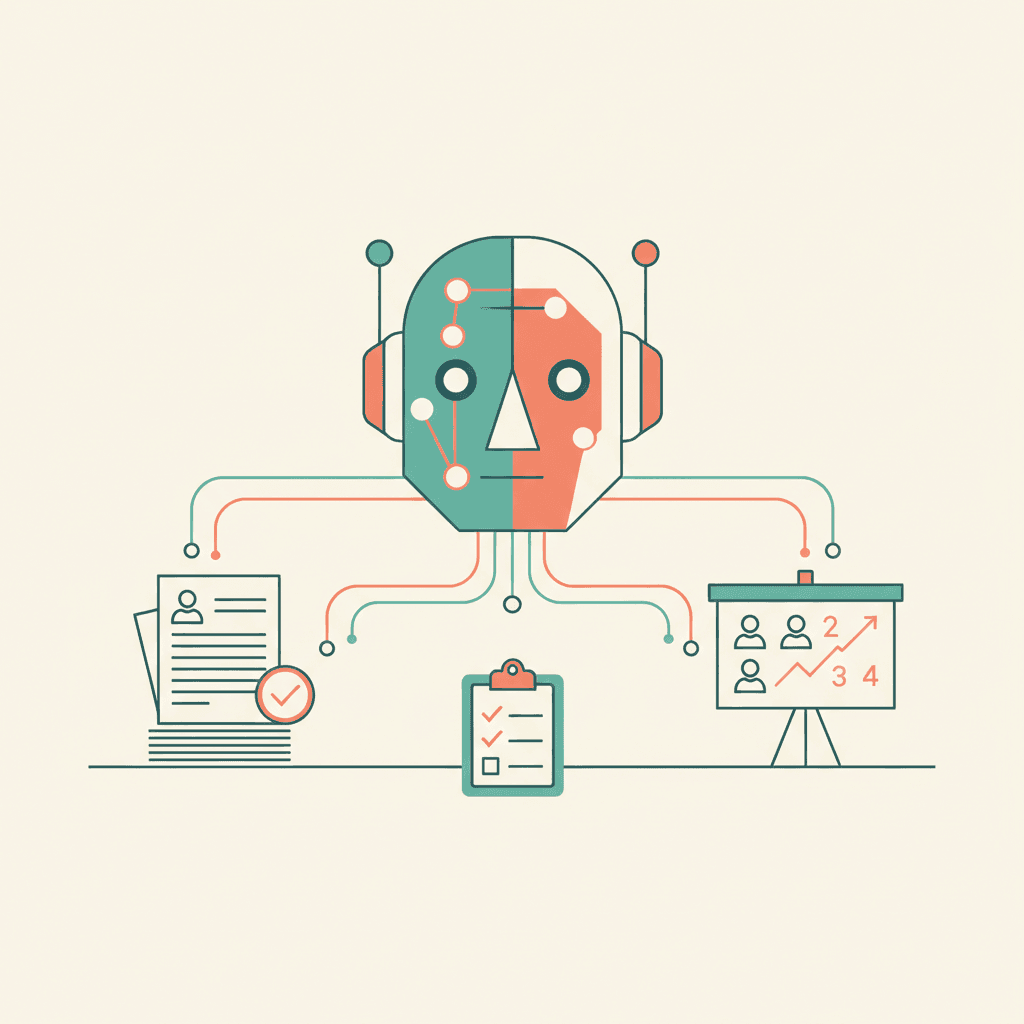
Agentic AI goes further. An AI agent receives a goal and works toward it independently. It plans steps, executes them, evaluates results, and adjusts its approach. Without you dictating every action.
In practice, this means: instead of automating individual tasks, an agent orchestrates entire workflows. It combines multiple tools, makes intermediate decisions, and delivers results that go beyond simple input-output logic.
Three Traits That Set Agentic AI Apart
- Autonomy: The agent decides its own next steps instead of waiting for instructions.
- Planning: It breaks complex tasks into subtasks and works through them sequentially.
- Tool use: It independently accesses external systems — databases, APIs, documents.
What Does This Mean for Recruiting?
Most AI recruiting tools today are reactive. You upload CVs, the system scores them. You ask a question, the system answers. The human remains the orchestrator.
Agentic AI shifts that boundary. Imagine:
- Automatic criteria generation: You describe a role in two sentences. The agent analyzes your previous job postings, derives criteria, and proposes a weighted scoring model.
- Proactive screening: New applications land in your inbox. The agent parses documents, extracts profiles, scores them against your criteria, and ranks results — before you open your laptop in the morning.
- Contextual follow-ups: The agent notices a candidate has relevant experience but a gap in their CV. It automatically drafts a polite follow-up email.
This is not science fiction. The technical building blocks already exist. The question is how fast they ship in production-ready products.
Why SMEs Benefit Most
Large enterprises have recruiting departments with 20 people, dedicated tech teams, and budgets for enterprise ATS platforms. SMEs do not.
That is exactly why agentic AI is compelling for smaller companies:
Fewer resources, bigger impact. An AI agent can handle tasks that would otherwise require an additional recruiter. Not as a replacement for human judgment, but for the repetitive groundwork: parsing, scoring, ranking, status updates.
No tech team required. Agentic AI abstracts technical complexity. You do not need to build workflows, configure automations, or maintain Zapier chains. The agent handles orchestration.
Scale without overhead. Whether you receive 10 or 200 applications per role, your workload stays the same. For SMEs with fluctuating application volumes, that is a real advantage.
Tools like HireSift are built for exactly this: AI-powered CV screening that automatically analyzes resumes, scores them against your criteria, and delivers a transparent ranking. The first step toward agentic AI — without enterprise complexity.
Know the Limits
Agentic AI is powerful, but it is not autopilot. In recruiting specifically, there are clear boundaries:
EU AI Act. Recruiting is classified as a high-risk application. Human oversight is mandatory. No agent may autonomously make hiring decisions. The final call always belongs to a human.
Transparency. When an agent acts independently, its reasoning must be traceable. Scoring models need to remain explainable. Candidates have the right to know how AI was involved in their evaluation.
Bias risk. More autonomy means more responsibility. When an agent derives its own criteria, you must ensure no discriminatory patterns creep in. Regular audits are mandatory — not optional.
Data quality. An agent is only as good as its data foundation. If your job descriptions are vague or your criteria contradictory, even the best agent will deliver poor results.
What You Can Do Right Now
You do not need to wait for the perfect agentic AI solution. The smartest strategy for SMEs:
- Start today. Use AI-powered CV screening as your entry point. You will save time immediately and build experience.
- Sharpen your criteria. The clearer your requirements, the better any AI system works — whether traditional or agentic.
- Document your processes. Agentic AI needs context. Teams that know and document their recruiting workflows will benefit faster.
- Ensure compliance. Familiarize yourself with the EU AI Act. If you already work GDPR-compliant and prioritize transparency, you are ready for agentic AI.
The Bottom Line
Agentic AI is the logical next step after the basic AI assistant. For SME HR teams, it means more automation with less configuration overhead. But also more responsibility for transparency and fair processes.
The technology is moving fast. If you start with AI-powered screening now, you build the foundation to adopt agentic AI the moment it matures — without starting from scratch.
Candidate data stored in the EU. AI processing on EU infrastructure.
CVs and profiles are stored permanently in Frankfurt. AI analysis runs in Paris or Belgium — encrypted, transparent, and without model training.
Request demoRelated Articles

AI recruiting without bias: how to screen fairly and transparently
AI can support fairer hiring when criteria, data quality and human review are designed with care.

AI Interview Questions: How to Make Hiring Conversations More Structured and Fair
AI can turn role criteria and CV signals into better interview questions. Learn how to use it without losing human judgement.

How to Identify Soft Skills in Applications Without Guesswork
Soft skills matter, but they are easy to misread. Learn how to assess signals in CVs and applications fairly and consistently.